
Beyond the Empty Plate...
... What Ramadan Is Teaching You About Power, Discipline, and the War Against the Nafs

There is a joke that circulates every Ramadan, usually from that one colleague who thinks he has discovered something profound. “You Muslims are just skipping lunch,” he says, grinning like he has dismantled centuries of theology with a single observation. The laughter that follows is halfhearted because the joke itself is tired, but also because it reveals something uncomfortable. He is wrong about Ramadan, but not entirely wrong about how some of us have come to practice it.
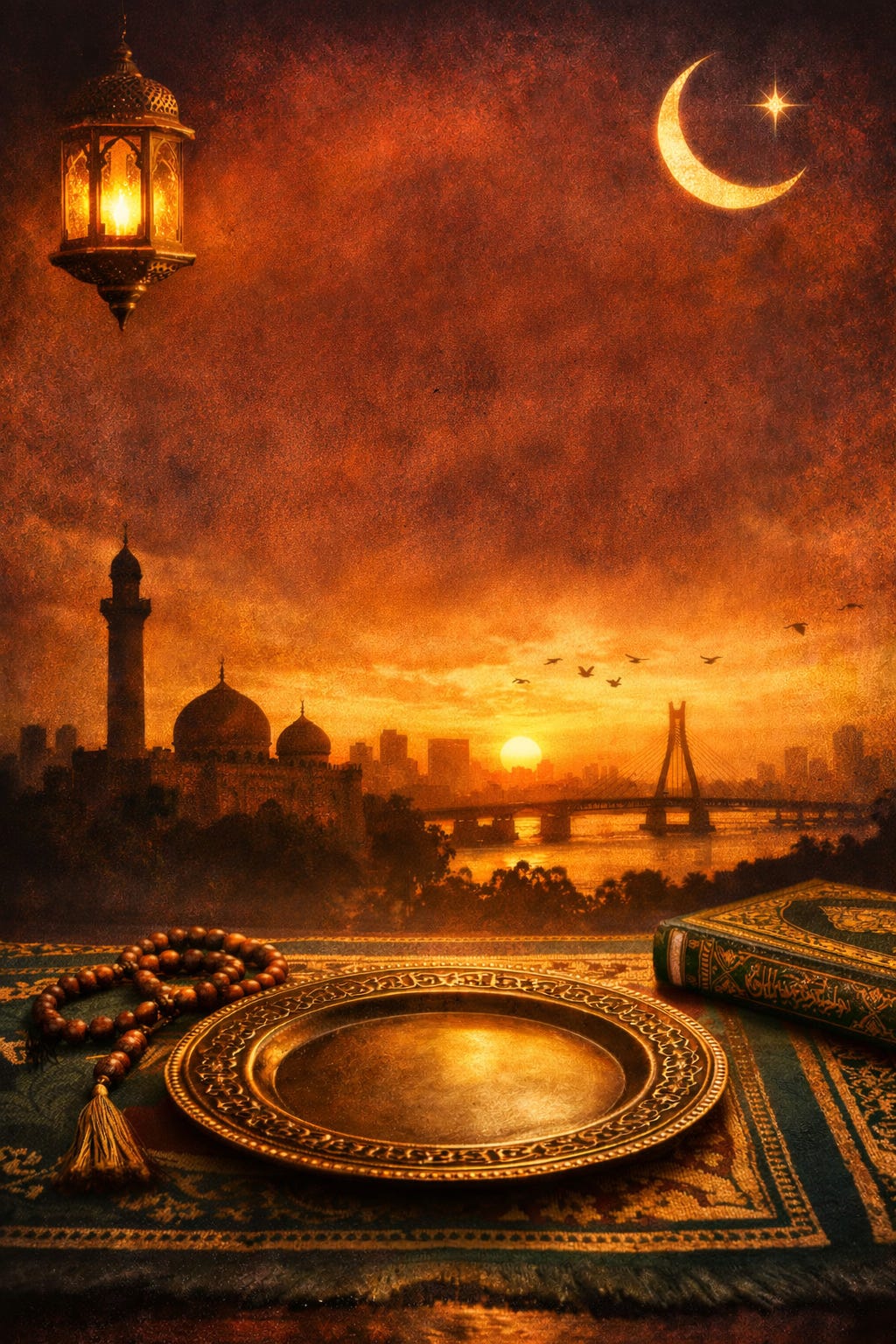
Scroll through Nigerian Muslim Twitter (I still refuse to call it X) during Ramadan and you will see what he means. “Light suhoor gang, where you at?” “Eba for suhoor is a war crime.” “If your iftar doesn’t have zobo, did you even fast?” The memes are endless. The food discourse is relentless, and while there is nothing inherently wrong with finding joy in the communal meals that bookend the fast, there is something worth examining in how the conversation about Ramadan has increasingly centred the thing we are abstaining from rather than the thing we are moving toward.
This is not a scolding (well, maybe) but also an invitation to reconsider what is happening during these 29 or 30 days, because if Ramadan is primarily about food, then the critics are correct. Skipping lunch is not a spiritual achievement. But if Ramadan is about something else entirely (something that food deprivation merely makes visible), then we are sitting on a practice that most of us have not fully understood, let alone fully experienced.
The Nafs and the War You Did Not Know You Were Fighting
The Quran speaks about the nafs in ways that suggest it is not a simple thing. Sometimes it is referred to as the nafs al-ammara, the self that commands evil. “Indeed, the soul is a persistent enjoiner of evil” (Surah Yusuf 12:53). Other times, it appears as the nafs al-lawwama, the self-reproaching soul that recognises its own failings. “And I swear by the self-reproaching soul” (Surah Al-Qiyamah 75:2). The highest station is the nafs al-mutma’inna, the tranquil soul at peace with its Creator. “O tranquil soul, return to your Lord, well-pleased and pleasing” (Surah Al-Fajr 89:27-28).
These are three states of the same soul, and the movement between them is the entire spiritual project of Islam. Imam Al-Ghazali, the great theologian and philosopher of the eleventh century, spent much of his masterwork, Ihya Ulum al-Din (The Revival of the Religious Sciences), mapping this internal terrain. He described the nafs as something that must be disciplined and ultimately transformed. Left to its own devices, it will pursue comfort, pleasure, status, and safety with single-minded determination. While these pursuits are not inherently evil, they become obstacles when they replace the remembrance of Allah as the organising principle of life.
This is where Ramadan enters. Fasting is not a punishment. Consider this: when you wake before dawn to eat, knowing that in a few hours your body will begin demanding food and you will refuse it, you are engaging in a very specific kind of practice. You are teaching the nafs that it does not get to be in charge. That its desires, no matter how insistent, are not commands. That there is something higher than appetite, something more important than comfort.
The Prophet Muhammad, peace be upon him, made this explicit. “Fasting is a shield” (Sahih al-Bukhari 1894). A shield protects. A shield stands between you and harm. The harm here is not physical hunger but the tyranny of unchecked desire. Every time you feel hungry and choose not to eat, you are practicing refusal. You are rehearsing the discipline you will need when the nafs demands something far more dangerous than food.
The Spartan Parallel and the Discipline of Denial
There is a reason military training involves deprivation. Soldiers are woken early, fed poorly, and pushed to exhaustion. The purpose is to build a particular kind of person. Someone who can function when comfort is not available and can override the body’s complaints in the service of a mission. The ancient Spartans understood this. Their entire society was organized around the production of warriors who could endure what others could not.
The same analogy applies to Ramadan, but with a different aim. The Spartan trained his body to serve the state. The Muslim trains the nafs to serve Allah. The means are similar (deprivation, discipline, discomfort), but the ends are entirely different. Where the Spartan sought dominance over others, the Muslim seeks dominance over the self. Where the Spartans’ training ended on the battlefield, the Muslim’s training continues for the rest of their lives.
This is why reducing Ramadan to “missing lunch” is grossly inaccurate. The person who thinks fasting is about food has misunderstood the entire exercise. Food is the tool, not the target. The target is the nafs, and the nafs is far more cunning than appetite.
Imam Ibn Qayyim al-Jawziyya, the fourteenth-century scholar and student of Ibn Taymiyyah, wrote extensively about the purification of the soul. In his book Madarij al-Salikin (The Stages of the Wayfarers), he described the spiritual path as a series of stations, each one requiring the abandonment of something the nafs clings to. Wealth, reputation, comfort, and even certain kinds of righteousness can become idols if the nafs is not continually checked. Fasting is one of the mechanisms by which this checking happens.
The Risk of Trivialization
The danger of the food discourse is not that it is wrong to enjoy iftar or to make jokes about suhoor. The danger is that when food becomes the primary frame through which we understand Ramadan, we lose access to its actual function. We turn a spiritual boot camp into a cultural festival. We trade transformation for performance.
This trivialisation is not unique to Muslims. The sociologist Max Weber, writing about Protestant Christianity in The Protestant Ethic and the Spirit of Capitalism, described how religious practices that were once oriented toward salvation gradually became secularised rituals oriented toward social cohesion and economic productivity. The outward form remained, but the inward substance drained away. What was once a tool for spiritual transformation became a marker of group identity.
Nigerian Muslims are not immune to this drift. When Ramadan becomes primarily about what you eat, when you eat it, and who you eat it with, the month retains its social function but loses its spiritual teeth. You still gather with family. You still break fast together. You still experience the rhythm of the day organised around prayer times. But the deeper work (the confrontation with the nafs, the practice of submission, the cultivation of taqwa (God-consciousness)) can quietly disappear beneath the noise of food talk and social performance.
Taqwa is the word the Quran uses to describe the goal of fasting. “O you who have believed, decreed upon you is fasting as it was decreed upon those before you that you may become righteous” (Surah Al-Baqarah 2:183). The Arabic word la’allakum tattaqun is often translated as “so that you may become righteous,” but taqwa carries a richer meaning. It suggests awareness and a kind of spiritual alertness to the presence and pleasure of Allah. The person with taqwa is not just someone who avoids sin but someone who has internalised the gaze of Allah to the point where their choices are shaped by that awareness, even in private, even when no one else is watching.
This is what fasting is meant to cultivate. When you refrain from food not because anyone is monitoring you but because Allah has commanded it, you are building the muscle of private obedience. You are training yourself to care about divine approval more than human approval and more than the immediate gratification the nafs is always demanding.
The Medieval Masters and the Science of the Soul
The Islamic scholarly tradition produced an extraordinary body of work on the purification of the soul. These were practitioners who spent decades engaged in the disciplines they wrote about. Their insights remain startlingly relevant because human nature has not changed in any fundamental way since the eleventh century.
Imam Al-Ghazali’s Ihya Ulum al-Din contains an entire volume on the inner dimensions of worship. He wrote about fasting as one of the “secrets” of Islam. Practices that appear simple on the surface but contain layers of meaning that only reveal themselves through sustained engagement. For Al-Ghazali, the act of fasting had at least three levels.
The first level is the fasting of the common people, which is abstaining from food, drink, and sexual relations during daylight hours. This is obligatory, and fulfilling it earns reward, but it is also the most superficial dimension of the practice.
The second level is the fasting of the elect, which entails guarding not just the stomach but all the senses. The eyes from looking at what is haram. The ears from listening to gossip or backbiting. The tongue from lies, slander, and idle talk. The hands from taking what does not belong to them. This is a more comprehensive fast, one that recognizes that the nafs seeks gratification through multiple channels, not just appetite.
The third level is the fasting of the elect of the elect, and it means emptying the heart of everything except Allah. This is the station of the saints and the prophets, people who have so thoroughly submitted their nafs that their consciousness is oriented toward the divine in every moment. For them, Ramadan is not a special month but the culmination of a discipline they practice year-round.
Most of us will never reach the third level, and that is fine. The point is not to measure ourselves against prophets. The point is to recognize that fasting has depths we have barely begun to explore, and that focusing on food keeps us perpetually at the first level when the second and third levels are where the real transformation happens.
Sheikh Abdal Hakim Murad, a contemporary British Muslim scholar, has written extensively about the challenge of maintaining spiritual practice in a consumer society. In his essay “The Poverty of Fanaticism,” he argues that modernity’s greatest threat to religious life is not persecution but distraction. We live in an environment engineered to capture and monetize attention and to keep the nafs perpetually excited and perpetually unsatisfied. Ramadan offers a monthly escape from this machinery, but only if we allow it to function as designed.
The Nigerian Context and the Pressure of Performance
There is a particular intensity to how Ramadan is observed in Nigeria. The iftars are lavish. The mosques are packed. The sense of communal participation is strong. This is beautiful in many ways, but it also creates pressure. When everyone around you is posting their elaborate iftar spreads on Instagram, when the standard for what counts as a “proper” suhoor keeps rising, when missing tarawih prayers feels like social failure rather than just a missed opportunity, the spiritual practice can start to feel like a performance.
This is not a uniquely Nigerian problem, but it plays out in specific ways here. In a society where religious identity is deeply tied to communal belonging, where being a “good Muslim” often means being seen as a good Muslim, the private dimensions of worship can get neglected. The fast that no one sees (the one where you are alone with your hunger and your thoughts and your awareness of Allah) becomes less important than the fast that gets documented and validated by your community.
The twentieth-century Egyptian scholar Sayyid Qutb, writing in In the Shade of the Quran, his monumental tafsir, emphasized that Islam is fundamentally concerned with the relationship between the individual and Allah. Community matters, but it is not the source of faith. “Say, ‘Indeed, my prayer, my rites of sacrifice, my living and my dying are for Allah, Lord of the worlds’” (Surah Al-An’am 6:162). The approval that matters is divine.
This does not mean we should abandon communal iftars or stop caring about how we observe Ramadan collectively. It means we should guard against allowing the social performance of Ramadan to crowd out its internal purpose. The nafs is perfectly happy to participate in religious rituals as long as those rituals do not threaten its dominance. It will fast, pray, and give charity, as long as it gets credit, as long as it feels righteous, and as long as it can maintain its sense of superiority over others. The real work of Ramadan is exposing these subtle forms of self-worship and dismantling them.
The Haters and the Internalisers
There will always be people hostile to Islam. Some of that hostility is ideological. Some of it is political. Some of it is simply the result of ignorance. The non-Muslim who reduces Ramadan to “skipping lunch” is revealing his own spiritual poverty more than he is revealing anything about Islam. He lives in a world where the only meaningful deprivation is accidental, where voluntary suffering makes no sense because there is no higher purpose to serve. He cannot understand fasting because he does not believe in the soul.
You cannot reason such a person into understanding. What you can do is live in a way that makes his dismissal obviously inadequate. When your fast produces patience, generosity, humility, and self-control, when the people around you notice that something has shifted in you during Ramadan, that is the refutation no argument can provide. The Prophet Muhammad, peace be upon him, said, “Many people who fast get nothing from their fast except hunger and thirst” (Sunan Ibn Majah 1690). The form without the substance is worthless. The substance, when present, is unmistakable.
This brings us back to the food discourse. Joking about suhoor is harmless in itself. Sharing recipes for iftar is fine. But when these things dominate the conversation to the exclusion of what Ramadan is for, we have a problem. We risk producing a generation of Muslims who observe Ramadan meticulously but who have never truly fasted. Who has never felt the nafs rebel and chosen submission anyway. Who has never experienced the strange clarity that comes from sustained hunger combined with sustained prayer. Who has never stood alone in the last third of the night and felt, even briefly, that Allah was near.
The Quran speaks to this: “And when My servants ask you concerning Me, indeed I am near. I respond to the invocation of the supplicant when he calls upon Me” (Surah Al-Baqarah 2:186). This verse appears in the middle of the Quranic passage about fasting. Fasting creates the conditions for nearness. Discipline opens space. The nafs, temporarily subdued, stops drowning out the still, small voice that has been there all along.
Internalising the Lessons
Ramadan ends. Eid arrives. Life returns to normal. And for many Muslims, the spiritual intensity of the month dissipates within days. The discipline we practiced for thirty days does not extend into Shawwal. The taqwa we cultivated does not survive contact with ordinary life. We go back to being the people we were before Ramadan, waiting for next year to try again.
This is the real tragedy, not that we enjoy iftar meals or joke about suhoor, but that we treat Ramadan as a temporary state rather than a training ground for permanent transformation. The nafs is patient and will endure thirty days of restraint if it knows freedom is coming on the other side. The point of Ramadan is not to restrain the nafs for a month. The point is to establish dominance over it so completely that restraint becomes the default for the rest of the year.
Sheikh Hamza Yusuf, an American Muslim scholar who studied extensively in the Muslim world, often speaks about the purpose of spiritual practice. He describes Islam as a “transformative tradition,” which means a set of practices designed to produce a particular kind of person. The rituals are not ends in themselves but tools. Praying five times a day is meant to create someone who lives in constant awareness of Allah. Zakat is meant to create someone who holds wealth lightly. Fasting is meant to create someone who can say no to the nafs when necessary.
The question to ask yourself at the end of Ramadan is not “Did I complete all the fasts?” It is “Am I different?” Has something shifted? Are the sins that felt irresistible before now resistible? Has the pull of Allah become stronger than the pull of the nafs? If the answer is no, then Ramadan has been observed but not experienced.
Closer to Allah, Further from Haram
The Quran describes believers as those “whose hearts tremble when Allah is mentioned” (Surah Al-Anfal 8:2). This is not fear in the sense of terror but awe mixed with love, and the recognition that you are in the presence of something infinitely greater than yourself. Ramadan is designed to cultivate this. When you are hungry and tired and still wake for tahajjud, when you are tempted to break your fast early and do not, when you bite back a cruel word because you are fasting, these small acts of obedience accumulate. They build a relationship with Allah that is lived and embodied.
And when that relationship strengthens, something else happens. The haram activities that once seemed appealing start to lose their grip. Not because you are strong, but because you have tasted something better. The pleasure of obedience to Allah becomes more compelling than the pleasure of sin. This is what the ulama call dhawq, the spiritual taste that comes from sustained practice. It cannot be explained to someone who has not experienced it, but once you have experienced it, everything else starts to seem hollow in comparison.
The real lesson of Ramadan, the one we risk missing if we focus too much on food, is that power is not found in satisfying the nafs but in mastering it. That freedom is not the absence of restraint but the ability to restrain yourself when necessary. That closeness to Allah is the only thing that produces lasting peace in a world engineered to keep you perpetually restless.
So by all means, enjoy your iftar. Share your suhoor jokes. Gather with family and friends. But do not let these things become substitutes for the harder, lonelier, more transformative work that Ramadan is asking of you. The food will be forgotten by next week. The discipline you build in these thirty days can last a lifetime.
Ramadan Mubarak. May Allah accept your fasts, elevate your station, and grant you the strength to carry its lessons into every month that follows.
Uh huh... I skipped launch, but this is a full-course meal
It can't be served better
Thank you
Very beautifully written جزاك اللهُ خيرًا